

Machine Learning Engineer Roadmap: From Python to a Deployed AI Product
Eight stages, 34 weeks, one project per stage: the path from Python and SQL to RAG, agents and a deployed AI product.
On this page
Key takeaways
- The path has eight stages: Python and SQL, statistics, classic ML, deep learning and NLP, GenAI with RAG and evaluation, agents, MLOps, then portfolio and hiring.
- At about 10 hours a week, a graduate who can code a little covers it in roughly 34 weeks.
- Evaluation sets a 2026 resume apart: show before-and-after numbers on a golden test set for every RAG project.
- Finish every stage with one deployed, documented project.
- Hiring managers open your GitHub, a live link and your metric choices before they read your resume.
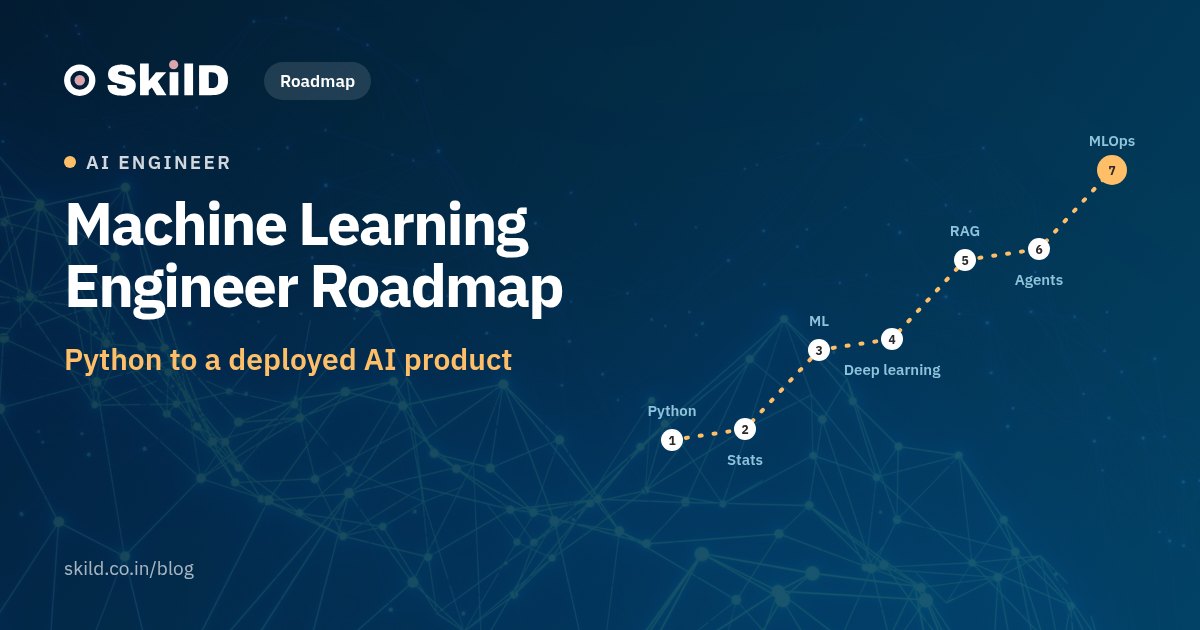
A machine learning engineer roadmap in 2026 runs in eight stages: Python and SQL, statistics, classic machine learning, deep learning and NLP, generative AI with retrieval and evaluation, agents, MLOps and LLMOps, and finally a portfolio and the hiring rounds. At about 10 focused hours a week, a graduate who can already write a little code covers it in roughly 34 weeks. You get the order, the tools and one project per stage, so every stage ends with something you can show a hiring manager.
Week 1 of a PG Program, free
Start stage 1 today with Week 1 of the AI Engineer PG Program, free in the Learning Hub with the code SKILDFREE, and earn a SkilD certificate for it.
Take it free→Why the ML engineer role now ends in a deployed AI product
The World Economic Forum's Future of Jobs Report 2025 ranks AI and machine learning specialists among the three fastest-growing jobs worldwide in percentage terms. In India the demand sits on top of public investment: the IndiaAI Mission was approved in March 2024 with an outlay of ₹10,371.92 crore, including compute of 10,000+ GPUs and a FutureSkills arm for AI education.
The job itself has stretched. A few years ago a machine learning engineer trained and tuned predictive models and handed them over. In 2026 most Indian job descriptions for "ML engineer", "AI engineer" or "GenAI engineer" ask for the same person to also build on large language models, wire up retrieval and agents, and ship the result behind an API at a known cost. That is why this roadmap ends with a deployed product, and why it keeps classic ML in the path: the interview loop still tests both.
| Role title | What the work centres on | What interviews test |
|---|---|---|
| Machine learning engineer | Training, tuning and serving predictive models on company data | Statistics, model choice, metrics, feature pipelines, deployment |
| AI engineer | Products built on foundation models: RAG, agents, fine-tuning, evaluation, cost | LLM system design, retrieval quality, evaluation, security, cost |
| MLOps engineer | Running models in production: CI/CD, monitoring, drift, retraining | Docker, cloud, model registries, observability |
The roadmap at a glance
The weeks assume about 10 hours a week, including practice. If you already write Python daily, you can move through stage 1 in half the time.
| Stage | Weeks | Core tools | Project you finish |
|---|---|---|---|
| 1. Python, SQL and engineering habits | 1–8 | Python, pandas, NumPy, pytest, PostgreSQL, Git, GitHub | The No-Show Model: a first model that beats a baseline |
| 2. Statistics and seeing the data | 9–10 | SciPy, statsmodels, Seaborn | An analysis with its uncertainty stated |
| 3. Classic machine learning | 11–16 | scikit-learn, XGBoost, LightGBM, Optuna, SHAP | The Credit Call: a lending model chosen by what a mistake costs |
| 4. Deep learning and NLP | 17–21 | PyTorch, Keras, Hugging Face Transformers, spaCy | The Complaint Desk: routing Hinglish complaints |
| 5. GenAI, RAG and evaluation | 22–24 | OpenAI, Anthropic and Gemini APIs, LlamaIndex, pgvector, RAGAS, Langfuse | The Policy Navigator: cited answers, tested |
| 6. Agents | 25–28 | LangGraph, MCP, CrewAI, Pydantic | An agent that acts behind an approval gate |
| 7. MLOps and LLMOps | 29–31 | FastAPI, Docker, MLflow, GitHub Actions, AWS or Azure, Evidently | A deployed model service with a cost and drift report |
| 8. Portfolio and hiring | 32–34 | GitHub Pages, Excalidraw | An end-to-end AI product in your own domain |
Before stage 1: the maths you need
You need four pieces of maths, and you need them in a working sense rather than for exams. Vectors and matrices are how every dataset, embedding and neural network layer is stored. Derivatives and the chain rule are how gradient descent and backpropagation learn. Probability is how you read a model's output and decide how sure to be. Python classes are how PyTorch models and most libraries are written.
Spend one week refreshing these with small exercises in a notebook. You will meet each one again, by hand, in later stages: linear regression from scratch, a neural network in NumPy, attention computed on a toy sentence. That is when it sticks.
In the same week, learn to use ChatGPT, Claude, Gemini and Copilot well, and learn to check what they tell you. You will use an AI assistant every day of this roadmap. The skill that matters is spotting when it is confidently wrong.
Stage 1: Python, SQL and working like an engineer (weeks 1–8)
Many ML interview loops in India open with a timed SQL or Python round, before any model is discussed. Treat this stage as the foundation everything else stands on.
What to learn
- SQL: SELECT, filtering and joins; GROUP BY; subqueries and CTEs; window functions; indexes and reading a query plan. Practise on PostgreSQL with a client like DBeaver.
- Python: types, functions, files and errors; testing with pytest; calling APIs and reading JSON; pandas and NumPy for cleaning and reshaping messy tables.
- Engineering habits: bash, file permissions and cron; Git branches and pull requests on GitHub; an AI coding assistant such as Copilot, Cursor or Claude Code used inside a repo, with tests that catch its mistakes.
Project for this stage
Build a training table in SQL, clean it with a tested Python script, then train The No-Show Model: a first classifier that predicts which appointments will be missed and has to beat a simple baseline. The baseline matters. Beating "predict the most common answer" is the first proof a model earns its place, and stating that comparison in your README shows judgement.
Stage 2: Statistics and seeing the data (weeks 9–10)
This stage teaches you to say how sure you are. Hiring managers notice it at once, because most portfolios report a single accuracy number with no sense of spread.
- Distributions, confidence intervals, hypothesis tests and statistical power
- A/B tests and the peeking problem: why checking results every day inflates false wins
- Exploratory analysis and visualisation with pandas and Seaborn; missing data and confounders
- Maximum likelihood, which is where loss functions come from, and PCA by hand
Project: take a public Indian dataset, for example from data.gov.in, answer one business question and write it up with the uncertainty stated. One page, one chart, one interval.
Stage 3: Classic machine learning (weeks 11–16)
Classic ML still runs most of the money decisions in Indian companies: credit, fraud, churn, demand. Learn how each core model learns, then learn to choose between them by what a mistake costs.
What to learn
- Bias and variance, overfitting, cross-validation
- Linear regression and gradient descent, written from scratch once; L1 and L2 regularisation
- Logistic regression and cross-entropy, KNN, Naive Bayes, SVMs
- Decision trees, random forests, k-means and hierarchical clustering
- Metrics chosen by cost: precision, recall, thresholds and class imbalance
- Feature engineering with a leakage audit; pipelines and tuning with Optuna; XGBoost and LightGBM
- SHAP explanations, and time-series forecasting with walk-forward validation
Project for this stage
The Credit Call: a lending model where you put a rupee cost on a wrong approval and on a wrong rejection, then pick the model and threshold that keep total cost lowest. Add SHAP explanations for three individual decisions. This one project answers a question every fintech interviewer asks: "why this metric?"
Stage 4: Deep learning and NLP (weeks 17–21)
The goal here is to understand exactly how a network learns, because that understanding is how you will debug fine-tuning, embeddings and retrieval later.
- The perceptron, activations and the forward pass; backpropagation with the chain rule; a network written once in NumPy
- The PyTorch training loop, with Keras side by side; optimisers, initialisation, batch norm and dropout
- CNNs and transfer learning on a Colab GPU
- Tokenisation and embeddings; RNNs, LSTMs and GRUs; why attention replaced them
- The transformer block (queries, keys, values); fine-tuning BERT; named-entity recognition
Projects: Field Doctor, a crop-disease image classifier built with transfer learning, and The Complaint Desk, which routes customer complaints written in Hinglish to the right team. Hinglish is where Indian text work gets interesting, and it is a detail interviewers remember.
Stage 5: Generative AI, RAG and evaluation (weeks 22–24)
This is the stage most published roadmaps skip, and the one that sets a 2026 resume apart. Building a chatbot over PDFs takes an afternoon. Proving it answers correctly takes the rest of the stage.
What to learn
- How an LLM produces text: next-token prediction and sampling (temperature, top-k, top-p)
- Calling the OpenAI, Anthropic and Gemini APIs; prompts and structured output
- RAG basics: chunking, embeddings and vector stores such as ChromaDB and pgvector, with LlamaIndex
- Better retrieval: hybrid search and reranking; access control, freshness and citations
- Evaluation: golden test sets, LLM-as-judge, RAGAS metrics such as faithfulness, answer relevancy and context precision, and a Langfuse or LangSmith dashboard
- Fine-tuning with LoRA, and how pre-training, instruction tuning and RLHF or DPO fit together
Project for this stage
The Policy Navigator: a RAG assistant over a set of policy documents that cites the exact passage behind each answer, respects who may see what, and ships with a regression test suite. Report faithfulness and answer relevancy on a golden set of 50 questions, before and after you add reranking. That before-and-after table is the strongest single line on a GenAI resume.
If your documents contain personal data, design for India's Digital Personal Data Protection Rules, notified on 14 November 2025. Failing to keep reasonable security safeguards can attract a penalty of up to ₹250 crore, so access control in retrieval is a business requirement from day one.
Stage 6: Agents and AgentOps (weeks 25–28)
An agent is a loop: the model picks a tool, reads the result and decides the next step. Write that loop once with plain Python, then move to LangGraph.
- Tools, memory and state; reasoning patterns such as ReAct, plan-and-solve, reflection and routers
- MCP, the Model Context Protocol: introduced by Anthropic in November 2024, adopted by OpenAI in March 2025 and donated to the Linux Foundation's Agentic AI Foundation in December 2025. It is now the common way to connect a model to tools and data.
- Context engineering; human approval gates; step and budget limits
- Security: prompt injection, guardrails and access
- Multi-agent teams with CrewAI; evaluating agents with tracing
Project: give The Policy Navigator an agent that can take an action, such as raising a request, only after a human approves it. Run it against a red-team checklist of injection attempts and publish the results.
Stage 7: MLOps and LLMOps (weeks 29–31)
A model on your laptop is a demo. A model behind an endpoint, with tests, a budget alert and a rollback, is a product. This stage turns your projects into the second kind.
- Ship it: FastAPI, Docker and a Streamlit or Gradio front end; the MLflow model registry; tests and CI/CD with GitHub Actions
- Run it on one cloud: AWS (Bedrock, SageMaker) or Azure (Microsoft Foundry). Set up keys, an IAM role and a budget alert in rupees first.
- Control cost: model routing, caching, rollback and a cost report per 1,000 requests
- Keep it fresh: drift detection with Evidently, data versioning with DVC, a feature store such as Feast, scheduled retraining, Grafana and Langfuse for observability
Project: a deployed model service with a public URL, plus a one-page report on cost, drift and when it should retrain.
Stage 8: Portfolio and hiring (weeks 32–34)
Spend the last stretch on two things: one end-to-end AI product in a domain you know, and the interview formats.
The interview rounds to practise
- System design: an ML system (say, fraud scoring), an LLM system (a support assistant) and an agent system, each drawn in Excalidraw with data flow, evaluation and cost
- Theory: derive gradient descent, explain bias and variance, explain attention
- Timed coding: Python, SQL and light data structures and algorithms
What hiring managers open first
| What they open | What convinces them |
|---|---|
| Your GitHub | Clean commit history, tests, a README that states the decision you made and why |
| A deployed link | It works on the first click, and the README shows the cost per 1,000 requests |
| Your RAG project | A golden test set and before-and-after evaluation numbers |
| Your classic ML project | A metric chosen by business cost, with a baseline beaten |
| Your portfolio page | Three to five projects, each with a one-line result, published on GitHub Pages |
India's hiring leaders already expect AI skills from every hire. In the Microsoft and LinkedIn 2024 Work Trend Index, 75% of leaders in India said they would not hire someone lacking AI skills. For an AI engineer the bar is proof you can ship, and the project at each stage is what that proof looks like.
Five habits that save you months
- Finish projects. Five deployed, documented projects beat twenty half-built notebooks.
- Write the baseline first. Every model and every RAG system gets compared against something simple.
- Measure before you tune. Build the test set before you change the prompt or the model.
- Keep tests around your AI coding assistant. It speeds you up when your tests catch its errors.
- Put a rupee figure on cost. Interviewers in India ask what a system costs to run. Have the number ready.
How SkilD teaches this
The PG Program · AI Engineer: ML, GenAI & Agentic AI follows this sequence over 34 weeks and 248 live hours, with 16 projects, including The No-Show Model, The Credit Call, The Complaint Desk and The Policy Navigator. Classes are live on weekends, Saturday and Sunday from 10 AM to 1 PM IST, taught by industry experts including faculty from Mastercard and Paytm. Every class is recorded and up within 24 hours. A live maths and Python bootcamp runs before week 1, and four project weekends give you a full weekend to finish a project, have it reviewed and catch up on anything you missed.
The program ends with an end-to-end AI product in your own domain, presented to a panel, on one of four tracks: GenAI, Agentic and AgentOps, MLOps, or Forward Deployed Engineer. Placement support runs until you hold an offer. SkilD has trained 4,200+ learners, now working at 39+ companies, and the highest recorded salary hike among them is 82%. You can see what learners build on the projects page.
The program needs a bachelor's degree. The first class is on Saturday 28 November 2026, and admission starts with a 1-on-1 call with a program advisor. If you want to try the method first, Week 1 of the program is free.
Frequently asked questions
How long does it take to become an AI engineer in India?
With about 10 focused hours a week, a graduate who can already write some code can cover the full path, from Python and SQL to a deployed AI product, in roughly 34 weeks. If you already code daily, the first stage goes faster.
Do I need advanced maths to become a machine learning engineer?
You need working knowledge of four things: vectors and matrices, derivatives and the chain rule, probability, and basic statistics. You use them to understand gradient descent, backpropagation and model output, and you can learn them alongside the code in the first weeks.
What is the difference between an AI engineer and a machine learning engineer?
A machine learning engineer trains, tunes and serves predictive models on company data. An AI engineer builds products on foundation models, such as RAG assistants and agents, and owns their evaluation and cost. Many Indian job descriptions in 2026 ask for both, so a complete roadmap covers both.
Should I learn machine learning or generative AI first?
Learn classic machine learning first. It teaches you baselines, metrics, overfitting and evaluation, which are exactly the skills you need to test a RAG system or an agent. Moving to GenAI after that takes weeks rather than months.
Which programming language should I learn first for AI?
Python, followed closely by SQL. Python runs almost every ML and LLM library, and SQL is tested in most data and AI interview rounds in India.
What projects should I build to get hired as an AI engineer?
Build three to five projects that each end deployed and documented: a classic ML model with a cost-based metric, an NLP or vision model, a RAG assistant with evaluation numbers, an agent behind an approval gate, and one end-to-end product in a domain you know.
PG Program · AI Engineer: ML, GenAI & Agentic AI
Live weekend classes, every class recorded, projects reviewed by faculty and placement support to the offer. First class Sat 28 Nov 2026.
Sources
- World Economic Forum, Future of Jobs Report 2025: the fastest growing and declining jobs (9 Jan 2025)
- PM India, Cabinet approves IndiaAI Mission (7 Mar 2024)
- Microsoft News Centre India, 92% of Indian knowledge workers use AI in the workplace: 2024 Work Trend Index (16 May 2024)
- Wikipedia, Model Context Protocol
- Ragas documentation, metrics
- Press Information Bureau, Digital Personal Data Protection Rules 2025 explainer (Nov 2025)
Keep reading
Machine Learning and AI Engineer Salary in India (2026): Up to ₹60 LPA by Experience and Role
AI and ML engineer pay in India by experience and role, with GenAI, MLOps and agentic AI figures, each with its source and date, and what raises your pay.
Data Engineering Roadmap for Beginners: A 9-Month Plan from Zero to Job-Ready (2026)
A stage-by-stage data engineer roadmap for India: what to learn each month, the tools to use, and one project to finish at every stage.
AI Roadmap for Working Professionals: Lead AI in Your Function Without Coding
Nine no-code stages, one deliverable each: from prompting and checking AI to n8n automations, agents and a rollout plan your manager signs.
Data and AI openings on WhatsApp, and the hiring market twice a month.
The roles the companies our learners work at are hiring for, and the dates of the next free live build. Read three issues of the Brief and you’ll know whether we’re your kind of school.
You’re on the list.
The first alert lands the next time our network is hiring, and the next Brief lands in your email.