

Python taught from week 5. Build the AI that ships.
Become a Machine Learning and AI Engineer in 34 weeks: build, deploy and run AI products, with LLMs, agents and MLOps for everyone, live on weekends.
A machine learning and AI course with placement support and real-time projects, for working professionals: weekends, live, with recordings.
Taught live by industry experts from Mastercard and Paytm.
Download the syllabusBook a 1-on-1 call with a program advisor
Every weekend live, every class recorded and up within 24 hours.
An end-to-end AI product, fifteen more along the way, and fifteen from-scratch labs.
GenAI, Agentic & AgentOps, MLOps or Forward Deployed, for your end-to-end project.
From week 20, with industry experts who have hired for the role.
Machine learning and AI engineer salary in India: up to ₹80 LPA.
Every company racing to ship AI needs people who can make a model work in production, and it pays well for the people who can.
- ₹10 LPAAverage, first 2 years
- ₹22 LPAAverage, 2–5 years
- ₹38 LPAAverage, 5–8 years
- ₹52 LPAAverage, 8+ years
- ₹80 LPATop 10%, 8+ years
recrew.ai India AI/ML Engineer salary guide, 2026 (averages by experience; ₹80 LPA is the top 10% at 8+ years) · recrew.ai India LLM Engineer guide, 2026 · MLOps: recrew.ai and TeamLease Digital GCC data, 2025.
Who this machine learning and AI program is for.
Working professionals who want the Machine Learning and AI Engineer title, and the shipped work to back it up.
Software engineer→ ML & AI engineer
You already ship code. This program adds the models, the LLMs and the title.
Data analyst→ Data scientist / ML engineer
Data and statistics every day, and models that belong to someone else. Here, the models become yours.
Data engineer→ MLOps / AI engineer
The pipelines are already yours. Here, the models that run on them, and the MLOps weeks that join the two.
A career break→ The next role
A gap changes nothing here. The program is about the next role, and it builds the route to it.
- A bachelor's degree in any stream
- Weekends: six hours live, Sat and Sun 10 AM–1 PM, plus 4–5 hours of practice recommended
- A laptop with 16 GB memory; GPU work runs in the cloud
- No Python needed on day one: it is taught in weeks 5–6, after a live maths and Python bootcamp before week 1
AI Engineer Fundamentals: an eight-week head start.
The first eight weeks of this program, sold on their own: AI, SQL, Python and Git from a standing start, ending in the No-Show Model, your first model. Your certificate ID carries into this program.
LLMs, agents and MLOps for everyone, then a track for your end-to-end project.
Everyone learns the whole stack: statistics, machine learning, deep learning, LLMs, agents and production, with a from-scratch lab most weekends. The track is where your end-to-end project goes deep, built with mentors in weeks 33 and 34.
LLM & GenAI Engineering
LoRA fine-tuning · LlamaIndex · pgvector · RAGAS · Langfuse · vLLM
OpensLLM Engineer · Generative AI Engineer
Certification routeNVIDIA-Certified Associate: Generative AI LLMs
Agentic & AgentOps, or Forward Deployed
LangGraph · CrewAI · MCP · Langfuse · enterprise connectors · for Forward Deployed: a client brief, ROI and a statement of work
OpensAgentic AI Engineer · Forward Deployed AI Engineer
Certification routeMicrosoft Certified: Azure AI Engineer Associate
MLOps & LLMOps
MLflow · Feast · DVC · Evidently · Grafana · Kubernetes, as a mentor demo
OpensMLOps Engineer · AI Platform Engineer
Certification routeAWS Certified Machine Learning Engineer – Associate
Hiring week takes ML, LLM and agent system design for everyone, because the next interview may ask about any of them.
Train it. Ship it. Watch it. Fix it.
The full machine learning and AI course syllabus: 34 weeks in four phases, four project weekends, and the job title each block opens as you reach it. The track is picked in week 33, for the end-to-end project. Open any phase for what gets built and the tools used.
Foundationsweeks 1–8 · 8 weeks
- W1–2AI Launchpad: how AI works, and the assistantsHow LLMs work · ChatGPT, Claude, Gemini and Copilot, and how to prompt them · NotebookLM and Perplexity · a first AI workflow · an AI concept hour each Saturday2 wks
- W3–4SQL for dataJoins · GROUP BY · CTEs · window functions · reading a query plan · a training table on PostgreSQL2 wks
- W5–6Python for dataFunctions and errors · pytest · APIs and JSON · pandas · NumPy · a tested cleaning script2 wks
- W7Linux, Git and an AI coding assistantbash · cron · Git branches and pull requests · an AI assistant inside a real repo1 wk
- W8Project weekend 1 · The No-Show ModelYour first model, built live with mentors from a template, beating a baseline1 wk
Machine & deep learningweeks 9–21 · 13 weeksOpensData Scientist · Deep Learning Engineer · Computer Vision Engineer · NLP Engineer
- W9–10Statistics and seeing the dataDistributions and intervals · hypothesis tests and A/B tests · exploratory analysis · missing data and confounders · PCA by hand2 wks
- W11–13Machine learningCross-validation · linear and logistic regression · KNN, Naive Bayes and SVM · trees and forests · clustering · metrics chosen by cost3 wks
- W14–15Better modelsFeature engineering and a leakage audit · tuning with Optuna · XGBoost and LightGBM · SHAP · time series and forecastingData Scientist2 wks
- W16Project weekend 2 · The Credit CallA lending model chosen by what a mistake costs, built live and graded1 wk
- W17–18Neural networks and visionBackpropagation · the PyTorch training loop, Keras side by side · optimisers and dropout · CNNs and transfer learning · Field DoctorDeep Learning Engineer · Computer Vision Engineer2 wks
- W19–20Sequences, attention and transformersTokenisation and embeddings · RNNs and LSTMs · attention and the transformer block · fine-tuning BERT · Hinglish textNLP Engineer2 wks
- W21Project weekend 3 · The Complaint DeskRouting Hinglish complaints, built live and graded1 wk
LLMs, agents & productionweeks 22–31 · 10 weeksOpensGenerative AI Engineer · LLM Engineer · AI Agent Developer · Agentic AI Engineer · Machine Learning Engineer · AI Engineer · MLOps Engineer · AI Platform Engineer
- W22–24LLMs, RAG and evaluationSampling and structured output · chunking, embeddings and vector stores · hybrid search and reranking · golden test sets and RAGAS · fine-tuning with LoRA · a tiny GPT from scratchGenerative AI Engineer · LLM Engineer3 wks
- W25–27Agentic AI and AgentOpsTools, memory and state · ReAct and LangGraph · MCP · approval gates and budget limits · prompt injection and guardrails · CrewAI teams · tracingAI Agent Developer · Agentic AI Engineer3 wks
- W28Project weekend 4 · The Policy Navigator gets an agentAn agent that acts behind an approval gate, run against a red-team checklist1 wk
- W29–30From notebook to productDocker from zero · FastAPI and a Streamlit or Gradio front end · MLflow and CI/CD · one cloud end to end, AWS or Azure · routing, caching, rollback and a cost reportMachine Learning Engineer · AI Engineer2 wks
- W31Running it in productionDrift and data versioning · feature stores and scheduled retraining · LLM observability, incidents and responsible AIMLOps Engineer · AI Platform Engineer1 wk
Career & end-to-end projectweeks 32–34 · 3 weeks
- W32Hiring weekML, LLM and agent system design · a theory round · timed Python, SQL and light DSA rounds · your portfolio page1 wk
- W33–34Capstone: the end-to-end projectPick a track: GenAI, Agentic & AgentOps, MLOps or Forward Deployed · built with mentors · presented before a panelForward Deployed AI Engineer2 wks
The end-to-end project · PG Program · AI Engineer: ML, GenAI & Agentic AI
One AI product built in your track · cost per thousand requests stated · presented live to a hiring panel
The detailed curriculum, the week-by-week timetable, every tool and the faculty, in one file.
- Every week and every topic, and the project tracks
- The timetable, with dates
- Every tool, by phase and track
- The faculty who teach it
Download it now. A program advisor calls within one working day to walk through it and answer anything it leaves open.
Your syllabus is ready.
A program advisor calls within one working day to walk through it.
Taught live by industry experts who build and teach these systems.
Taught live on weekends, with doubts answered in the weekday channel and the Saturday doubt clinic.




Try a free live build, and meet the faculty before you apply.
Ninety minutes, live and free. Our industry experts build a working AI tool from scratch while you build it alongside, chat open. It's the clearest way to see how a session here works. Next sessions: Sat, 17 Oct 2026 or Sat, 24 Oct 2026, 11:00 IST.
Your seat is saved.
The joining link reaches you on WhatsApp, with a reminder on the day.
Three things that make thirty-four weeks work.
Hands-on, from week one
Every block ends in something trained, shipped or measured in a personal repo, reviewed by the faculty, and four project weekends to finish and catch up.
The tools companies hire for
PyTorch, LangGraph, MLflow, FastAPI, Docker and the rest of the stack, with a certification route for your track.
Built around a full-time job
Live on weekends, every class recorded and up within 24 hours.
What a week looks like.
Everyone moves through the same week on the same deadline, so a bad week costs you a replay, not the cohort.
- 01The brief, firstWhat you'll build this week, and what done looks like. Before the session, not after.
- 02Build it liveOn screen with the industry expert teaching it, chat open, your question answered on the call.
- 03Finish itStarted in the room, finished by the deadline, in a personal repo.
- 04Feedback, weeklyFrom the faculty every week. Marks come only when a test or project is due.
- 05Bring what brokeThe Saturday doubt clinic, 3–4 PM, and a weekday doubt channel, for the model that won't train and the service that won't start.
- 06It carries forwardEvery block hands its work to the next. The model from the machine learning weeks is the service in week 30.
A machine learning course with real-time projects: one AI product shipped end to end, and the projects that build up to it.
Each lives in a personal repo, and each is finished when it does the job it would do in production. An interviewer can open it and run it.
Your own AI product, presented live to a hiring panel.
One problem in the track picked in week 33, taken from a baseline to a deployed, monitored service with its cost per thousand requests stated, presented to a panel that has hired for this role.
- How it works
- From week 8 the models beat a baseline. From week 16 they are judged in rupees. From week 24 they include LLMs with an evaluation set, from week 28 agents behind an approval gate, and from week 30 they run as services. In weeks 33 and 34 the track shapes the product: an adapted LLM, an agent system with its red-team report, a platform that retrains itself, or a client build.
- Where it is used
- The same shape runs a lender’s credit decisions, an insurer’s policy assistant, a retailer’s support desk, and the demand forecast behind a distributor’s orders.
- What it proves
- That you can build, ship, run, cost and explain an AI product. Every piece of it can be opened in an interview.
Projects along the way
Four project weekends and the builds between them, the same for everyone. Everything leads into the end-to-end project:
The No-Show Model
Missed clinic bookings, predicted a day ahead: your first model, built live with mentors from a template, and beating a simple baseline.
Proves you can take raw data to a model that beats a guess.
→The Credit Call
Loan-default prediction on Indian lending data, with the decision threshold set by what a bad loan costs.
Proves you can argue for a model in rupees, not in accuracy.
→Field Doctor
A crop-disease image classifier trained on a small dataset with transfer learning, reported class by class.
Proves you can make deep learning work on the data a company has.
→The Complaint Desk
Consumer complaints routed automatically, Hindi-English code-mixed text included, with a classical baseline beaten and the comparison written up.
Proves you know when a transformer earns its cost.
→The Policy Navigator
A retrieval assistant over insurance policy documents, shipped with an evaluation set and a score, and a test suite that runs on every change.
Proves you can measure an LLM application, and improve the number.
→The Policy Navigator gets an agent
The assistant now acts: an agent that drafts and files the next step behind an approval gate, then run against a red-team checklist.
Proves you can let an agent act on a system, safely.
→The Model in Production
A model shipped as a FastAPI service in Docker on AWS or Azure, with a demo front end, a cost report, drift checks and scheduled retraining.
Proves you can keep a model right long after launch day.
→Every project is reviewed by the faculty who teach it.
Six lines every machine learning and AI engineer’s resume needs. Yours will have all six.
Machine Learning & AI Engineer · LLM & GenAI
Projects
- End-to-end AI product an adapted LLM behind a deployed service, cost per thousand requests stated, presented to a hiring panel
- The Policy Navigator retrieval assistant with an evaluation set: faithfulness scored before and after every prompt change
- The Credit Call loan-default model, threshold set in rupees, three predictions explained with SHAP
Technical skills
- Modelling classical ML, tuned, validated and explained
- Deep learning PyTorch, transfer learning, transformers
- LLM engineering retrieval, evaluation, prompts under test
- Agents tools, approval gates, step and cost budgets
- Deployment APIs, containers, CI, one cloud end to end
- Production monitoring, drift, cost, rollback
See what your resume is missing for a machine learning and AI role.
Three fields open it. Then upload your resume or answer four questions. Your skill report arrives within 10 minutes: the lines already there, the ones this program adds, and the closest title today.
Your analysis is on its way.
A program advisor calls within one working day to walk through it.
Placement support: five steps to your first machine learning and AI job.
The resume is the raw material. From hiring week to the first offer, this is the work done on it, step by step.
- 1Week 32The whiteboard roundsML, LLM and agent system design, timed, with feedback, plus your portfolio page and the README a hiring manager reads first.
- 2End-to-end projectThe panelYour AI product, presented to people who have hired for this role, with their notes added to the portfolio.
- 33+ roundsThe mock interviewsFrom week 20, with industry experts who have hired for this role. Recorded, with feedback, and repeated until ready.
- 43+ reviewsThe portfolio reviewEvery project checked against what an interviewer opens first, before any application goes out.
- 53+ introductionsThe introductionsWarm introductions into the 39+ companies our learners work at, a job board of the roles they're hiring for, and support that continues [support window to come].
Our learners work at 39+ companies.
The introductions in step five go into this network.


 amazon
 Swiggy
 Twitter
 ByteDance
 PayPal


 Flipkart


 ATLASSIAN
Training a team? 12+ organizations bring us in to train their own engineers, on their own stack. Plan a program for your team →
Every AI product in the country needs engineers who can ship it and keep it running.
Demos get the headlines. Production gets the pager.
A demo takes an afternoon. Companies hire for the harder part: a model or an LLM that is measured, deployed, monitored and costed, and still right next quarter. The companies racing to ship AI are hiring the people who build that layer. This program builds it.
From where they were to where they are.
The Policy Navigator was the first thing I built that came with a number. In my interview they asked how I knew the answers were grounded, and I opened the evaluation set on screen.
For three years I wrote reports about models other people built. The machine learning weeks were the first time I built one myself and explained a single prediction to my manager with SHAP.
Two years away, and the field had moved. So had the syllabus. The red-team report from the agent project weekend came up in every interview I had, and I could walk them through each attack.
Two machine learning and AI certificates an employer can verify in ten seconds.
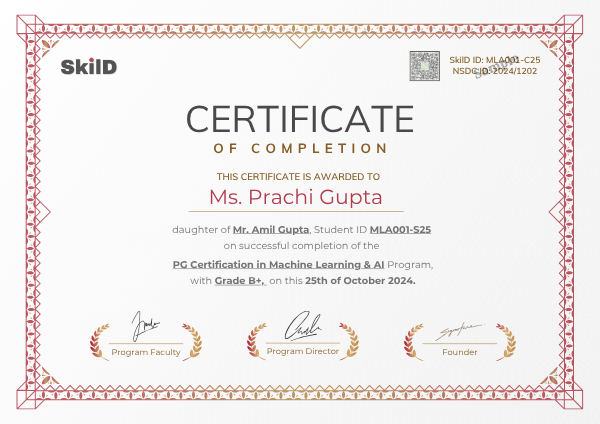
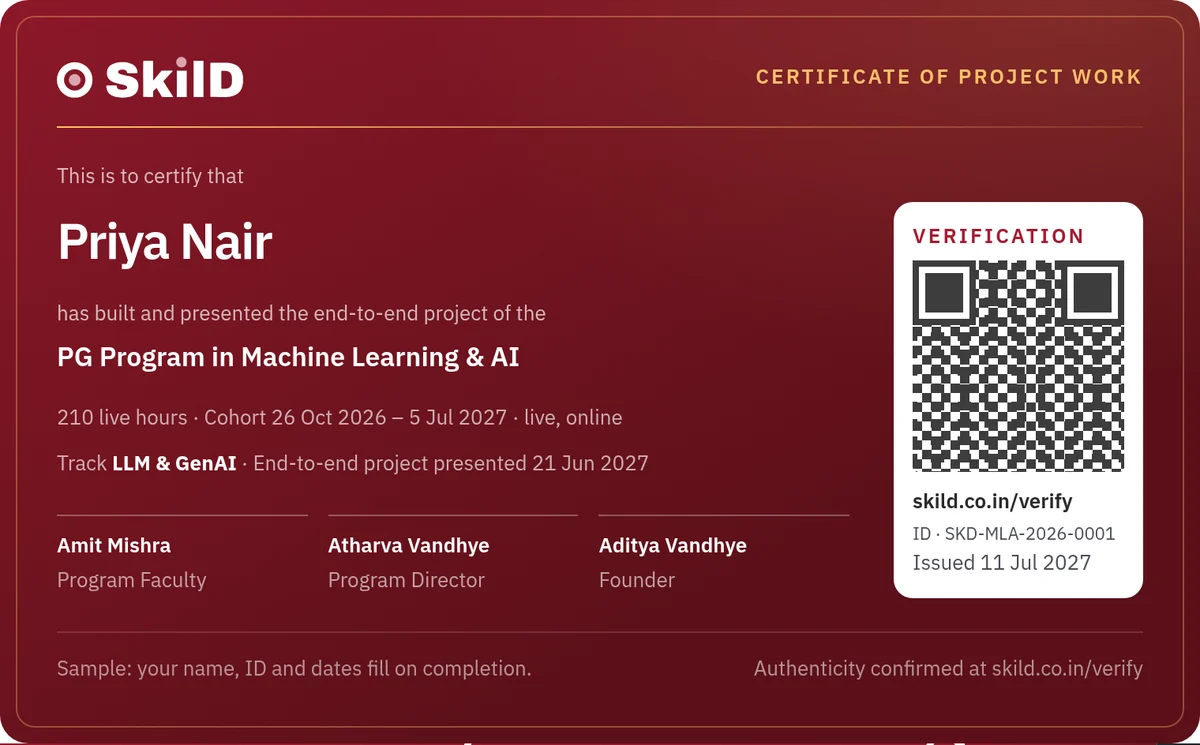
Two certificates for shipped work, not attendance, each with a verification ID an employer can check.
Awarded by SkilD on completion. What each certifies, and the bar that earns it, is stated in full on enrolment. Your track also maps onto a vendor certification route, from NVIDIA, Microsoft or AWS.
One fee for the machine learning and AI course, everything included.
From ₹3,516 a month on EMI, GST included.
- Program fee₹1,14,000
- Phase discountsApplicable
The fee follows the admission phase. Phase 2 closes 11 Oct 2026; the fee rises when Phase 3 opens on 12 Oct 2026.
30 seats. When the cohort fills, it closes and the next dated cohort opens.
- All 34 weeks, the project track included, taught live by industry experts
- The end-to-end project, and every project along the way
- GPU and API credits for your approved projects
- 3+ mock interviews
- Portfolio reviews and introductions
- Your track's certification route
All amounts include GST. Students, people coming back from a break and women in tech: ask about financial aid on your 1-on-1 call.
Why 34 weeks, and not three months?
A short course teaches the tools. Employers hire the person who has shipped a model, watched it drift, fixed it and explained what it costs. That takes 34 weeks of weekends.
| The route | What it usually gets you | What 34 weeks here gets you |
|---|---|---|
| YouTube and free courses | Everything, in the wrong order, and nobody to ask when a training run fails. | A fixed sequence, and the industry expert teaching it answering in the session. Start with AI Engineer Fundamentals |
| Self-study with a notebook and an API key | One demo built well, and no way to know what was missed. | An end-to-end AI product and the projects that build up to it, each finished to a standard set by industry experts who run these systems. |
| A master's or a diploma | Two years, a far larger fee, and a syllabus written before LLMs and agents reached production. | Thirty-four weeks of weekends, on the tools companies are hiring for this quarter. Fee a stretch? Students, people coming back from a break and women in tech can ask about financial aid |
| A large-batch course | A crowded room, a recording, a support ticket. | A room of thirty, an industry expert teaching it live, your name known by week three. |
From your application to your first live session.
- 1ApplyTen minutes, right here.
- 2Eligibility checkA bachelor’s degree in any stream, and the right starting point for you.
- 31-on-1 call with a program advisorWithin one working day: the timetable, the faculty and the fee.
- 4Reserve your seatHolds your seat and locks this phase’s fee.
- 5Join the cohort WhatsAppYour confirmations and the cohort’s updates arrive here.
- 6Call with your Student Success ManagerYour plan and your accounts, set up.
- 7Bootcamp and setupA live maths and Python bootcamp runs on four weekdays before week 1, two hours each, with a setup session for your GPU notebook and API keys.
- 8First live session28 Nov 2026.
- One price, everything includedevery project, every clinic, every mock interview.
- Live means livea room of thirty, every question answered in the session.
- Dates that holdplan your months around us.
- A mentor who knows your namefirst reply within one working day.
- Miss a weekwatch the recording, then bring your questions to the Saturday doubt clinic.
- Everything you build is yourscode, projects, portfolio. For good.
Start your application.
Three short steps. Step one takes a minute; finish the rest now or later.
Details saved.
Two short steps finish the application, now or later. A program advisor calls within one working day either way.
Your application is in.
A program advisor calls you within one working day with the timetable, the faculty list and the cohort calendar.
Aiming at something next to machine learning and AI? Take the fifteen-minute skill check or see the other programs, and we'll map the route with you.
Machine learning and AI course: your questions, answered.
What is a machine learning and AI engineer's salary in India?
Up to ₹80 LPA for AI/ML Engineers (recrew.ai, 2026), up to ₹1 Cr+ for LLM Engineers (recrew.ai, 2026) and up to ₹60 LPA for MLOps Engineers (recrew.ai and TeamLease Digital GCC data, 2025). Engineers who fine-tune, build retrieval and run LLMs in production earn 20–40% more than generalists, and the highest salary hike a SkilD learner has recorded is 82%.
What does an AI engineer do all day?
Connects a model or an LLM to a product, measures whether its answers are right, ships it as a service, and watches its cost and drift once people use it. Weeks 22–24 are the measuring, weeks 29–30 the shipping and week 31 the watching.
What is the difference between a machine learning engineer and an AI engineer?
A machine learning engineer trains models on a company's own data and runs them in production. An AI engineer builds products on large models: retrieval, agents, evaluation. Weeks 9 to 21 and 29 to 31 are the first job, weeks 22 to 28 the second, which is why this program carries both titles.
I've done machine learning courses before and still can't ship anything end to end. What's different here?
An end-to-end AI product and the four project weekends that build up to it, each deployed or measured: not exercises, but systems to open in an interview and walk someone through.
Can I learn machine learning with no coding background?
Yes. A live maths and Python bootcamp runs before week 1, and weeks 3 to 7 teach SQL, Python and Git from first principles. Those first eight weeks are also sold on their own as AI Engineer Fundamentals, 60 live hours, if you want to start smaller.
Can I move into AI engineering from software engineering or data analysis?
They are two of the fastest routes in. Software engineers already ship code, so the production weeks will feel like home and the machine learning weeks will stretch. Analysts already know data and statistics, so the statistics weeks will feel like home and deep learning and LLMs will stretch.
Which project track should I choose: GenAI, Agentic AI, MLOps or Forward Deployed?
The one the roles you want ask for. Everyone learns LLMs, agents and MLOps first, the track is picked in week 33 for the end-to-end project, and hiring week covers system design across all of them, so the choice never narrows the options.
Do I need a GPU or paid API keys for the AI course?
A GPU of your own is not needed: GPU work runs in cloud notebooks. API keys are set up before week 1 with hard spend caps, credits cover approved projects, and week 30 teaches cost per request, routing and caching, which interviewers ask about.
Can I do this machine learning course while working full time?
It's built for people with jobs: six hours a week live on weekends, Saturday and Sunday 10 AM–1 PM, with 4–5 hours of practice a week recommended, and every class recorded and up within 24 hours. The cohort moves together on a fixed schedule, which is why people finish.
What are the machine learning and AI course fees?
The program fee is ₹1,14,000 including GST. Phase discounts apply while a phase is open. It covers all 34 weeks including the project track, the end-to-end project and every project along the way, GPU and API credits, mock interviews and placement support. EMI from ₹3,516 a month.
Can I pay the AI and ML course fee in EMIs?
Yes, from ₹3,516 a month. The provider and terms come with your application.
What machine learning and AI certification do I get?
A SkilD certificate on completion, with a verification ID, plus a mapped route to your track's vendor certification (NVIDIA for LLM & GenAI, Microsoft Azure for Agentic AI, AWS for MLOps & LLMOps), so the 34 weeks feed straight into a credential employers already recognize.
Is this an AI and ML course with placement support?
Yes, in five steps from hiring week: timed whiteboard rounds and a question bank, a hiring-panel review of your end-to-end project, mock interviews with people who have hired for this role, portfolio reviews, and introductions into the 39+ companies our learners work at.
Is a machine learning job guaranteed after the course?
The offer is won in the interview, and everything here is built so you walk in ready: a deployed AI product to open on screen, a panel's notes on it, a published portfolio, and the hard questions answered three times already in mock interviews.
Do you run machine learning and AI training for companies?
Yes. We run this program for teams, built around the team's stack and data. Plan a program for your team →

Most people will use AI. Join the ones who ship it.
Thirty-four weeks from now, this could be your job: an AI product shipped, a portfolio worth walking someone through, one track known in depth, and a market that pays up to ₹80 LPA for exactly this work.
Not ready to apply yet? Save a seat at the free live build.
Machine learning and AI openings on WhatsApp, and the hiring market twice a month.
The roles the companies our learners work at are hiring for, and the dates of the next free live build. Read three issues of the Brief and you’ll know whether we’re your kind of school.

You’re on the list.
The first alert lands the next time our network is hiring, and the next Brief lands in your email.
ChatGPT · Python · PostgreSQL · Git
scikit-learn · pandas · NumPy · PyTorch · TensorFlow · Hugging Face
LangGraph · CrewAI · FastAPI · Docker · MLflow · AWS
✓ 120 golden questions loaded
✓ top-5 recall 0.91
✓ every answer cites its clause
✓ faithfulness 0.78 → 0.89
 Priya
Priya Kabir
Kabir Meera
Meera Rohit
Rohit Ananya
 Imran
Imran