
Cleaning the same messy export by hand, every week?
Python for Data: a Python course for data work, from your first script to tested pandas, in 2 weeks, live.
For analysts, freshers and anyone heading into data engineering or AI: Python, pandas and NumPy on real, messy files, with tests that prove it works, placement support and a certificate an employer can verify.
Taught live by industry experts from Mastercard and Paytm.
★ 4.7 from our pilot batch · 4,200+ learners trained by SkilD · learners at 39+ companies
Free · 90 minutes, live with our faculty · next date announced soon

Thirty people on the same two weeks, with one chat for questions.
The Clean Table, and three builds on the way to it.
Resume, portfolio review, mock interview, job alerts and introductions.
Named after your project, so an employer sees the work.
Data engineer salary in India: up to ₹80 LPA.
Every AI product runs on a pipeline somebody built, and companies pay well for the people who build them.
- ₹8.5 LPAAverage, first 2 years
- ₹18 LPAAverage, 2–5 years
- ₹32 LPAAverage, 5–8 years
- ₹46 LPAAverage, 8+ years
- ₹80 LPATop 10%, 8+ years
recrew.ai India Data Engineer salary guide, 2026 (averages by experience; ₹80 LPA is the top 10% at 8+ years) · PlugScale GCC benchmark, 2026 · 6figr, India.
Who Python for Data is for: a Python course for data work.
People who want Python for the data jobs they do or want, not for building websites.
An analyst on Excel→ The export cleans itself
The steps you repeat by hand every week become a script you run once, with tests that catch a bad file.
A fresher or student→ Python an interviewer asks for
Functions, files, errors, tests, pandas and APIs: the Python data roles screen for.
Heading into data or AI→ The Python both roles need
The same two weeks run inside the Data Engineering and AI Engineer PG Programs, so you start either one already writing it.
After SQL for Data→ The second half
SQL asks the question; Python gets messy files into a shape SQL can use.
- No Python experience needed
- Your weekend mornings for two weeks, live
- A laptop with 8 GB memory; every tool is free
- English you can follow in a live class
Go further with a PG Program.
Data Engineering and AI Engineer both run these two weeks of Python, then take you to a new role, live, with placement support through to offer. You arrive with your Python already in hand.
Seven tools, free to start, the ones data teams write Python with every day.
Installed with the helpline before the first live session.
- Any laptop from the last five years, with 8 GB memory
- Python, VS Code and Jupyter, installed with the helpline
- A free GitHub account, where your project lives
- Everything runs on a laptop: no cloud account or card needed
Stuck on setup? WhatsApp the helpline and someone walks you through it, step by step. Every tool stays on your laptop after the course.
Write it. Test it. Clean it.
The full Python for Data syllabus: two weeks, two parts, and a tested script at the end.
Core Pythonweek 1 · 6 hrsYou leave able toWrite Python that reads files, handles errors and is tested.
- W1Python fundamentalsData types, functions, file I/O and exception handling · unit testing with pytest · REST APIs and JSONBuild: a script that reads files and an API, with its tests6 hrs
Python for tablesweek 2 · 6 hrsYou leave able toLoad, clean and reshape real data with pandas and NumPy.
- W2Data manipulation with pandas and NumPypandas · NumPy · data cleaning and transformationBuild: a tested data-cleaning script6 hrs
The Clean Table · Python for Data
A messy export cleaned by a script with a test on every rule, and resume lines to explain in any interview.
The detailed Python for Data syllabus and the timetable, in one PDF.
- Every topic, week by week
- The timetable, with dates
- The tools, and the setup guide
- The Clean Table brief
Download it now. The helpline is on WhatsApp if a question comes up.
Your syllabus is ready.
Questions? The helpline answers on WhatsApp.
Taught live by industry experts who write Python for data every day.
They answer in the cohort chat between sessions, and review the work you hand in.



A two-week plan, mapped with a program advisor.
Get your two-week plan: a program advisor calls within one working day and maps where Python fits your next role. Or WhatsApp the helpline now.
Your plan is on its way.
A program advisor calls within one working day to walk through it.
Three things that make two weeks work.
Hands-on, from the first hour
Every week ends in code run on real files, reviewed by the faculty.
The tools data teams use
Python, pandas, NumPy, pytest and Jupyter, free to start.
Built around a full-time job
Weekend mornings, and every class recorded and up within 24 hours.
What a weekend looks like, and the help around it.
Everyone moves through the same week on the same deadline, with the same thirty people.
- 01The brief, firstWhat you’ll write this week, and what done looks like. Before the session, not after.
- 02Write it with the facultyOn screen with the faculty, chat open, your question answered on the call.
- 03Finish itStarted in the session, finished by the deadline, pushed to your GitHub.
- 04Reviewed, every weekYour work checked by the expert who set it, so you know where you stand.
- 05Bring what brokeAsk in the cohort chat, or bring it to the next session.
One Python project you can show: the Clean Table, a messy export cleaned by tested code.
It lives on your GitHub, and it is finished when every test passes and the row counts reconcile from file to table.
The Clean Table: a messy export, cleaned by a script with a test for every rule.
An export arrives with the brief, with the usual mess: repeated rows, blank prices, dates written three ways, a column that changed name halfway. You write the Python that cleans it in pandas, a pytest check for every cleaning rule, and a clean table at the end.
- How it works
- Week 1 builds functions, files, errors, tests and API calls. Week 2 adds pandas and NumPy, then the cleaning script.
- Where it is used
- The same script cleans a weekly sales export, a vendor file or an API pull before anyone builds a report on it.
- What it proves
- That you can take the files data teams actually receive and make them trustworthy, with tests to show it.
- What it does
- Cleans a messy export into a table SQL can use, with a test for every rule.
- Tech stack
- PythonpandasNumPypytest
- Key challenge
- Dates written three ways, made into one, without losing a row.

Three builds on the way
Each one becomes a piece of the Clean Table.
Files and Errors
A script that reads a folder of files, skips a broken one with a clear message and writes a summary.
Done when: a broken file is reported, not crashed on.
Proves the ability to write Python that survives real files.
An API, Tested
Data pulled from a public API as JSON, shaped into rows, with pytest checks on the result.
Done when: the tests pass on a fresh run.
Proves the ability to bring outside data in safely.
Reshaped in pandas
A raw table reshaped in pandas and NumPy: joined, grouped, pivoted and checked against the source.
Done when: the totals match the source file.
Proves the ability to get a table into the shape a report needs.
The faculty who teach it review every project.
Placement support: five steps from the course to a role that asks for Python.
The Clean Table is the raw material. These five steps put it in front of hiring teams.
- 1Week 2Your resume and LinkedInRewritten around the Clean Table and reviewed line by line.
- 2Week 2Your portfolio reviewYour GitHub checked against what an interviewer opens first.
- 3After week 2A mock interviewA Python round with an industry expert, recorded and reviewed.
- 4From week 2Job alertsData openings on WhatsApp, as they open.
- 5From week 2IntroductionsTo hiring teams in the SkilD network, as roles open.
Check your resume against these roles first → · Going further? See the PG Programs →
Our learners work at 39+ companies.
Where people who learned with SkilD work now.


 amazon
 Swiggy

 Twitter

 ByteDance
 PayPal


 Flipkart


 ATLASSIAN

Training a team? 12+ organizations bring us in to train their own people, on their own work. Plan a program for your team →
Every AI system in the country runs on a pipeline somebody built.
Models get the headlines. Pipelines get the pager.
Every AI product shipping now runs on data somebody moved, cleaned, tested and scheduled, and the companies racing to ship AI are hiring the people who build that layer. This course is where you start on it.
One Python certificate an employer can verify by its ID.
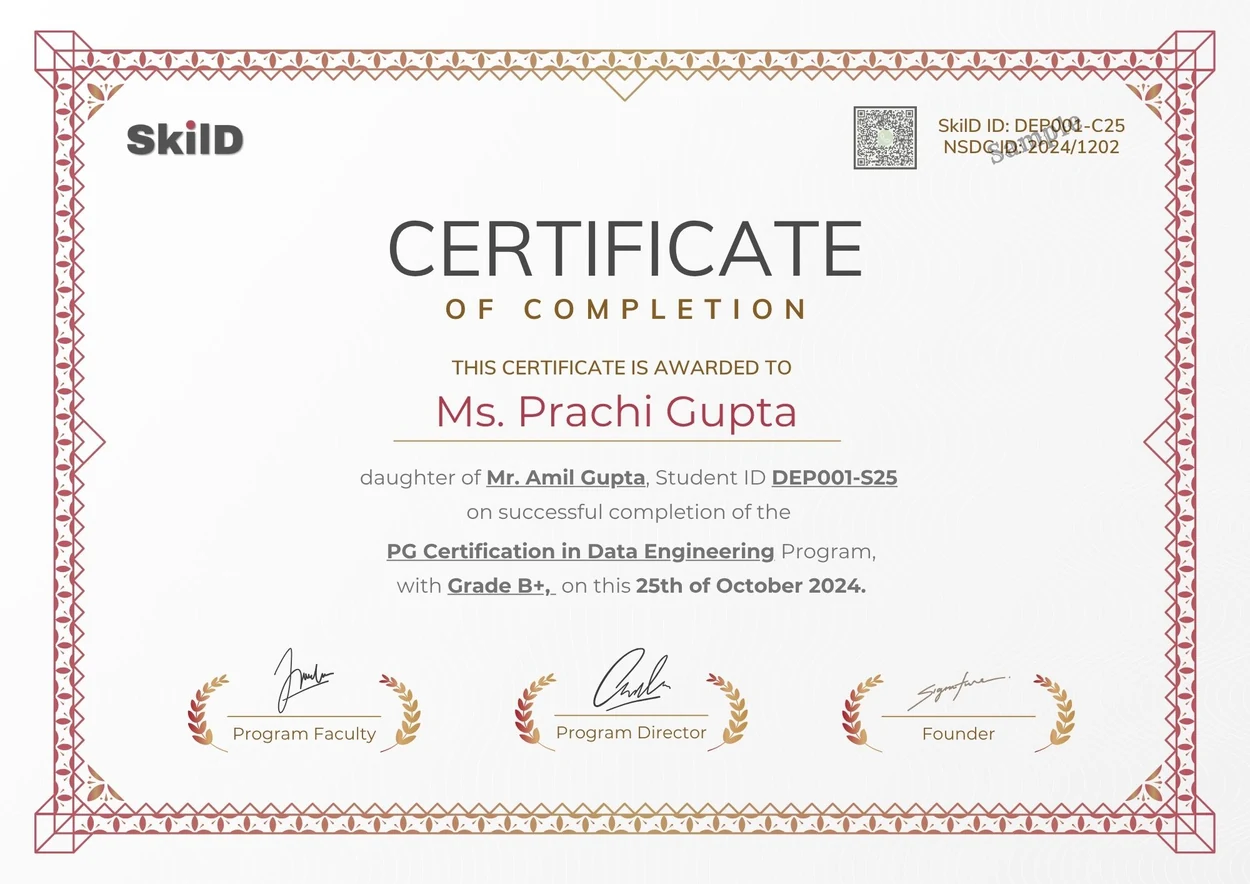
Awarded when your project is complete and every build passes its review, with a verification ID anyone can check.
Awarded by SkilD on completion, and checked at skild.co.in/verify. It names the Clean Table, so an employer sees the work itself, with the ID to prove it.
One fee for the Python course, everything included.
About ₹583 a live hour.
- Both weeks, taught live
- The Clean Table and three builds on the way
- Placement support
- Every session recorded
- The weekday doubt channel and the Saturday doubt clinic
- The certificate
Training a whole team? Plan it with us →
Why two weekends, live?
Plenty of ways to learn Python. Here is what each one usually gets you.
| The route | What it usually gets you | What 2 weeks here gets you |
|---|---|---|
| YouTube and free courses | Syntax on toy examples, and nobody to ask when the real file breaks the script. | A real, messy file, and the faculty answering in the session. |
| A recorded course | Videos you mean to finish. | A live session every weekend, a deadline that keeps you moving, and placement support after. |
| A general Python course | Games and websites, before any data. | Files, tests, APIs and pandas: the Python data work runs on. |
From enrolment to your first script.
- 1EnrolTwo short steps
- 2Pay onceYour seat is held for this cohort
- 3Join the cohort groupOn WhatsApp, with your batch
- 4Setup callWith the helpline, before day one
- 5First live sessionOnline, with your faculty
10 AM to 1 PM IST. Week 1 opens with your first script on real files.
Seat confirmed. Welcome to the February cohort.10:02
- ✓Python
- ✓VS Code
- ✓Jupyter
- ✓GitHub
The joining link for Saturday is pinned above.Fri 6:00 PM
- IReverse-Engineered CurriculumWe plan your learning backward from the career outcome you want.
- IICurated AdmissionYour advisor recommends a path only when it matches your background and ambition.
- IIIResponsive SyllabusYour cohort shapes the curriculum. When your batch asks for a topic, we add it.
- IVIndustry-Standard ToolsYou learn live, on the software and platforms the industry uses today, with no simulations.
- VBuild to ProveEvery project you finish becomes a portfolio asset.
- VISystems ThinkingWe teach you to design the whole system before you build any part of it.
- VIIExpert ValidationYou present your projects to industry veterans and explain the choices behind them.
- VIIILifetime Placement SupportOur support doesn't end at graduation; it accelerates your career long after your last class.
Enrol in Python for Data.
Two short steps, then payment. About three minutes.
Details saved.
One more short step, then payment.
Python for Data · cohort begins Sat 6 Feb 2027
GST included. Pay securely online. Course access and cohort details follow on email and WhatsApp.
You are enrolled.
Your confirmation and the cohort WhatsApp link arrive within minutes. The helpline sets you up before day one.
Python course: your questions, answered.
Do I need to know coding for this Python course?
No. Week 1 starts from your first script, and the helpline installs Python, VS Code and Jupyter with you before the first session.
What will I be able to do after Python for Data?
Write Python functions that read files and handle errors, test them with pytest, pull JSON from an API, and load, clean and reshape tables with pandas and NumPy.
Which Python libraries does the course teach?
pandas, NumPy, pytest and requests, in VS Code and Jupyter.
Should I take SQL for Data first?
It helps, and it runs just before, from Sat 23 Jan 2027. Python for Data also works on its own.
Who can enrol in Python for Data?
Anyone who can follow a live class in English: students, freshers, analysts, working professionals and people coming back after a break, from any stream.
What laptop do I need for the Python course?
Any laptop from the last five years with 8 GB memory, on Windows, Mac or Linux.
Can I talk to someone before I enrol in Python for Data?
Yes. WhatsApp the helpline, or ask for a call back and a program advisor calls you with your two-week plan.
How much time does the Python for Data course take?
Two weekends, Saturday and Sunday mornings, plus a little practice on your own.
What are the Python for Data course fees?
₹6,999 including GST, once. It covers both weeks taught live, the Clean Table and three builds, placement support and the certificate.
What if I miss a session of the Python course?
Every class is recorded and up within 24 hours. Watch it, then bring your questions to the Saturday doubt clinic.
Do I get a Python certificate?
Yes, with a verification ID an employer can check. It is awarded when the Clean Table is complete and every build passes its review.
Is there placement support after Python for Data?
Yes, in five steps: your resume and LinkedIn, a portfolio review, a mock interview, job alerts and introductions to hiring teams in the SkilD network, as roles open.
What comes after Python for Data?
A PG Program in Data Engineering or AI Engineer, if you want the whole road to a new role. You arrive with your Python already in hand.
Two weekends from now, the Monday export could clean itself.
Python, tests, an API and pandas, a tested cleaning script on your GitHub, and placement support, for ₹6,999.
Want to look first? Download the syllabus or get a call back.
Data and AI openings on WhatsApp, and the hiring market twice a month.
The roles the companies our learners work at are hiring for. Read three issues of the Brief and you’ll know whether we’re your kind of school.
You’re on the list.
The first alert lands the next time our network is hiring, and the next Brief lands in your email.
Book a 1-on-1 call with a program advisor.
Thirty minutes on the syllabus, the dates and the fee, and which program fits where you want to go.