

Been told to "look at agents" at work?
Agentic AI Foundations: an agentic AI course for beginners. Build an AI agent that runs on its own, safely, in 8 weeks, live.
Start from zero, with no coding needed: 24 live hours on the four agent patterns, tools and MCP, and guardrails; one agent built, tested and attacked in the session, then left running for a week. Placement support, and a certificate an employer can verify.
Taught live by industry experts from Mastercard and Paytm.
★ 4.7 from our pilot batch · 4,200+ learners trained by SkilD · learners at 39+ companies
- 7 daysran on its own
- 312emails handled
- 14 / 14attacks blocked
Taught live by the industry expert who teaches the module.
One Agent That Runs, and three builds on the way to it.
Resume, portfolio review, mock interview, job alerts and introductions.
With a verification ID an employer can check.
AI skills and pay: 25–45% increases within a year of moving into AI.
Every team now has AI tools. The people who can put them to work are scarce, and companies pay for scarce skills.
- 25–45%Salary increase within a year, for people who move into AI roles
- 30–40%Hike on a job switch for scarce skills, against a 9.1% average
- ₹25 LPAAverage base pay, AI Product Manager
TeamLease Digital, 2025 · Michael Page India Salary Guide 2026 (9.1% is the average hike) · Glassdoor India, AI Product Manager, 2026.
Who this agentic AI course is for.
Anyone asked to bring agents into their work, starting from zero.
Operations, support or admin→ An agent that runs
Modules 1 to 4 run on a no-code canvas. Code is shown, the code road is optional, and the certificate is the same either way.
Manager or team lead→ A decision to stand behind
Agent, workflow or neither, decided on paper before anything is built, with the cost per run known first.
Writes some code→ Agents at depth
The loop written by hand once in Python, so the framework stops being magic, then compared like for like with the canvas version.
Student or fresher→ A first agent on your resume
One agent that ran a week on its own, with its test set and its attack report: the two things interviewers ask about.
- Zero prerequisites: coding, maths and AI background are all optional
- Three hours a week, live
- A laptop and a browser
- Free accounts on n8n and one model provider, set up with the helpline in week one
PG Program in Applied AI: 22 weeks to the AI lead role in your function.
Finish this course first and you start the program with an agent already running. The program adds automation at depth, internal apps, a function track and The Adoption File, a business case presented live to a panel.
Build it on a no-code canvas, then in code if that suits.
An agent is the same idea on both roads: a model, tools, memory and a stop. The canvas is the default road; the code road is optional and teaches the Python it uses. Twelve tools in all, set up with the helpline in week one.
No-code road
n8n · its AI Agent node · MCP · Google Sheets · Gmail
For:anyone, from a standing start
Module 5:a two-agent team on the canvas, a researcher and a writer, with a check between them
Code road
Python · LangGraph · structured output · Langfuse tracing
For:anyone who wants the loop by hand once, with notebooks provided and every line explained
Module 5:the module 4 agent rebuilt in code, with step, time and budget limits
Both roads earn the same certificate, and module 9 is built on the road picked.
- Nothing to buy. Any laptop from the last five years, and a browser
- n8n on its free trial or free self-hosted edition, set up with the helpline
- One model provider on its free tier or trial, with a spending cap set before the first run
- A free GitHub account, where the agent's files live
Stuck on setup? WhatsApp the helpline and someone walks through it with you. Every agent and log built here is kept for good.
Define it. Give it tools. Build it. Attack it. Run it.
The full agentic AI course syllabus: ten modules in four parts, twenty-four live hours. Module 5 has two roads: the canvas or the code.
The idea and the toolsmodules 1–2 · 4 hrsYou leave able toTell an agent from a workflow, and give a model tools it uses correctly.
- M1What an agent isReason, act, observe, repeat · a model, tools, memory and a stop · the types of AI agent, in plain words · where a plain workflow wins · agent, workflow or neither, decided on paper · cost per task and per month2 hrs
- M2Tools and MCPA tool: name, description, typed arguments · function calling, live · the description as the prompt that matters most · MCP servers for a sheet, a mailbox and a search · reading a trace, call by call2 hrs
Patterns and your first agentmodules 3–4 · 6 hrsYou leave able toUse the four agent patterns, and run a no-code agent with an approval gate.
- M3The four agent patternsReflection: the agent checks its own draft · tool use · planning: the steps before the action · multi-agent: a researcher and a writer · one lab for each, on a business task3 hrs
- M4Your first agent, no codeThe n8n canvas · a fixed workflow first, for contrast · the AI Agent node, its model and its prompt · the module 2 tools attached · memory · a person approving before anything irreversible · rate limits and a cost ceiling3 hrs
Second build and guardrailsmodules 5–7 · 8 hrsYou leave able toBuild the agent a second way, then test it, attack it, fence it in and watch what it costs.
- M5Build it again: canvas team or codeCanvas road: a two-agent team with a check between them · code road, optional: the loop by hand once in Python, then LangGraph with state, nodes and a decision edge · the handoff between two agents: what is passed, and what is checked · structured output · every tool call logged · the two builds compared like for like3 hrs
- M6Evals, guardrails and a person in the loopThe four failures: wrong tool, wrong argument, no stop, confident nonsense · a 20-task test set and a pass rate · step, time and budget limits · prompt injection, direct and indirect · attacking your own agent · what always goes to a person, in writing3 hrs
- M7Monitoring and cost controlReading the run log, run by run · failure alerts by email · cost per run tracked against the module 4 ceiling · a cheaper model for the easy steps · the go-live check, then the agent switched on to run by itself2 hrs
Your agent and the road onmodules 8–10 · 6 hrsYou leave able toGive an agent your documents to work from, show an agent that ran a week on its own, and choose the next road.
- M8Memory and retrievalShort-term and long-term memory · giving an agent your documents: chunks, embeddings and search, in plain words · answers that cite their source · a retrieved document as an injection path, tested · built on a copy, so the running agent's week stays untouched3 hrs
- M9Project · One Agent That RunsOne recurring task · timed before the agent exists · built on the chosen road, approval gate from day one · switched on at the end of week 6 · a week unattended, with failure alerts · timed again in week 8, and the attack pass repeated · presented to the cohort2 hrs
- M10The road onWhich road the build points to · what the PG Program in Applied AI adds · what the PG Program in Machine Learning & AI adds on the code road · resume lines1 hr
One Agent That Runs · Agentic AI Foundations
A working agent with its test set, its attack report and a before-and-after measurement, a certificate with a verification ID, and resume lines to explain in any interview.
The detailed agentic AI course syllabus, the timetable and who teaches each module, in one PDF.
- Every module and topic, both roads
- The timetable, with dates
- All twelve tools, by part and by road
- The setup guide for week one
Download it now. The helpline is on WhatsApp if a question comes up.
Your syllabus is ready.
Questions? The helpline answers on WhatsApp.
Taught live by industry experts who build and teach these systems.
Each module has an industry expert who teaches it live and answers in the cohort chat between sessions.




Get your 8-week plan, mapped onto the work you want an agent to do.
Leave your number and a program advisor calls within one working day with a plan built around the daily work: the task worth giving an agent in module 9, and the road, canvas or code, that suits it best. Or WhatsApp the helpline now.
Your plan is on its way.
A program advisor calls within one working day to walk through it.
Three things that make eight weeks work.
Hands-on, from week one
Every module ends in something that runs or something tested, reviewed by the expert who teaches it.
The tools agent builders use
n8n, MCP, LangGraph, Langfuse, ChatGPT, Claude and six more, on free tiers or trials.
Three hours a week, fixed
The same slot each week, every class recorded and up within 24 hours.
What a week looks like.
Everyone moves through the same week on the same deadline. Same days, same time IST, every week.
- 01The brief, firstWhat you'll build this week, and what done looks like. Before the session, not after.
- 02Build it with the expertOn screen with the industry expert who teaches the module, chat open, your question answered on the call.
- 03Finish it on a live taskStarted in the session, finished by the deadline, on a task from the day job.
- 04Scored, weeklyBy the expert who teaches it, so where things stand is clear every week.
- 05Bring what brokeWhatsApp the helpline, or bring it to the next session.
One project an interviewer can open: One Agent That Runs, a week on its own, measured before and after.
It runs on a task from the day job, and it is finished when it has handled that task for a week with a person approving what matters.
One Agent That Runs: an AI agent that handles one task from the day job, unattended for a week.
One recurring task is picked and timed before the agent exists. The agent is built on the chosen road, with a person approving anything irreversible, and left running through week 7 with failure alerts wired. Then, in week 8, the task is timed again, the attack pass repeated, and what changed presented, including one thing it got wrong.
- How it works
- From module 2 it has tools. From module 4 it runs on a canvas with an approval gate. From module 6 it has a test set, limits and an attack report. From module 7 it has failure alerts and a cost watch, and runs by itself.
- Where it is used
- The same shape runs a support desk's first reply, a sales team's lead research, an accounts team's invoice checks and an operations desk's order lookups.
- What it proves
- That you can build an agent a team is willing to leave running, and show what it did in numbers.
Three builds on the way
Each one becomes a piece of One Agent That Runs.
Market Research Agent with a Self-Check
Researches a company or a product, drafts a one-page brief, then critiques and revises its own draft before anyone reads it.
Done when: the revised brief fixes what its own check found.
Proves you can make an agent check its own work.
Customer Enquiry Router Agent
Reads each incoming enquiry, looks up the order in a sheet, drafts a reply and routes it, with a person approving before anything is sent.
Done when: an empty, a hostile and a very long enquiry are each handled safely.
Proves an agent can decide while a person stays in charge.
Agent Test Set and Attack Report
Twenty tasks with expected results, a pass rate before and after a fix, and every injection attempt logged: what got through, and what changed.
Done when: the pass rate is stated and every attack has an outcome.
Proves you can show an agent is safe to leave running.
Every project is reviewed by the faculty who teach it.
Five lines your resume gains in eight weeks.
Operations Analyst · AI agents
Projects
- One Agent That Runs an enquiry agent left running for a week, approval gate on every reply, time on the task measured before and after
- Agent Test Set and Attack Report a 20-task pass rate, and every injection attempt logged with its fix
Skills
- AI agents the four patterns, tools, MCP and memory
- No-code automation n8n and its AI Agent node, with approval steps
- Agent safety evals, step and budget limits, a person in the loop
See what your resume is missing for a role building AI agents.
Three fields open it. Then upload your resume or answer four questions. Your skill report arrives within 10 minutes: the lines already there, the ones this course adds, and the closest title today.
Your analysis is on its way.
The helpline is on WhatsApp if you want to talk it through.
Placement support: five steps from the course to your first role building AI agents.
One Agent That Runs is the raw material. These five steps put your project in front of hiring teams.
- 1Module 10Your resume and LinkedInRewritten around One Agent That Runs and reviewed line by line.
- 2Week 8Your portfolio reviewThe agent, its test set and its attack report checked against what a hiring manager opens first.
- 3After week 8A mock interviewAn agent-design round with an industry expert: the build walked through and one agent designed live, recorded and scored.
- 4From week 8Job alertsAgent and automation openings on WhatsApp, as they open.
- 5From week 8IntroductionsTo hiring teams in the SkilD network, as roles open.
Check your resume against these roles first → · Going for the AI lead role? See the PG program →
Our learners work at 39+ companies.
Where people who learned with SkilD work now.
Training a team? 12+ organizations bring us in to train their own people, on their own processes. Plan a program for your team →
Every company is talking about agents. The people who can build a safe one are scarce.
Demos get the headlines. Guardrails get the job.
An agent demo takes an afternoon. Teams hire for the harder part: an agent with the right tools, a test set, limits on cost and steps, and a person approving what matters. This course builds that part from week one.
From where they were to where they are.
I was asked to look at agents with no coding background. By week four my enquiry agent was drafting replies from the order sheet, and I approved each one.
The attack report is what the interview was about. They asked how I stopped the injection, and I opened the log.
I came to see what the fuss was about. My agent ran a week on its own, and I joined the Applied AI program to take it across my team.
One agentic AI certificate an employer can verify by its ID.
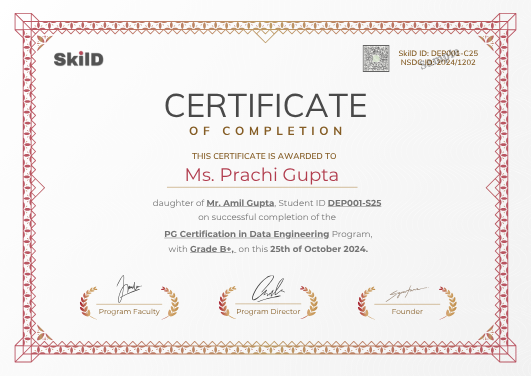
Awarded when your agent runs and every build passes its review, with a verification ID anyone can check.
Awarded by SkilD on completion, and checked at skild.co.in/verify. It names One Agent That Runs, so an employer sees the work itself, with the ID to prove it.
One fee for the agentic AI course, everything included.
About ₹417 a live hour, GST included.
- List price
₹11,110 - Your fee₹9,999 · 10% off
- GSTIncluded
Pay once, at enrolment. Your seat is confirmed on WhatsApp within minutes.
30 seats. When the cohort fills, the next dated cohort opens.
- All ten modules, both roads, taught live
- One Agent That Runs and three builds on the way
- Placement support in five steps
- Replays within 24 hours
- The helpline on WhatsApp, first reply within [X] minutes
- The certificate, with a verification ID
- A weekday doubt channel and a Saturday doubt clinic
All amounts include GST. Model and tool usage runs on free tiers or trials, with a cost ceiling set in module 4. Training a whole team? Plan it with us →
Why 8 weeks, live?
Plenty of ways to learn about AI agents. Here is what each one usually gets you.
| The route | What it usually gets you | What 8 weeks here gets you |
|---|---|---|
| YouTube and free courses | Agent demos in the wrong order, and nobody to ask when one loops. | A fixed order, and an industry expert answering in the session. |
| A recorded course | Videos you mean to finish, on someone else's agent. | A personal agent, a deadline each week, and placement support after. |
| Building alone with a framework | An agent that runs once, and no way to know what it does on the hundredth run. | A test set, limits, an attack report and a week unattended. |
| The PG Program in Applied AI | The whole road to the AI lead role, with agents at work across a team, in 22 weeks, with placement support through to offer. | 8 weeks and ₹9,999 to start, with an agent already running when you move up. See the PG program → |
From enrolment to your first live session.
- 1EnrolTwo short steps, right here.
- 2Pay₹9,999, once. Your seat is confirmed.
- 3Join the cohort WhatsAppYour confirmations and the cohort's updates arrive here.
- 4Setup with the helplinen8n and a model account opened, with a spending cap, before day one.
- 5First live session[date layer]
- One price, everything includedevery live session and its replay, every project review, and placement support.
- Live means livea room of thirty, every question answered in the session.
- Dates that holdplan your months around us.
- A mentor who knows your namefirst reply within one working day.
- Miss a weekwatch the recording, then bring your questions to the Saturday doubt clinic.
- Everything you build is yourscode, projects, portfolio. For good.
Enrol in Agentic AI Foundations.
Two short steps, then payment. About three minutes.
Details saved.
One more short step, then payment.
You are enrolled.
Your confirmation and the cohort WhatsApp link arrive within minutes. The helpline sets you up before day one.
Want the whole road instead? See the PG Program in Applied AI.
Agentic AI course: your questions, answered.
Do I need coding for this agentic AI course?
Zero code is needed. Modules 1 to 4 run on a no-code canvas, and the code road in module 5 is optional, with notebooks provided and every line explained. The certificate is the same on either road.
What are the types of AI agents?
The textbook list usually runs to six: simple reflex, model-based, goal-based, utility-based, learning, and multi-agent systems. Module 1 explains them in plain words, and module 3 builds the four patterns working agents use today: reflection, tool use, planning and multi-agent.
How can I learn AI agents from scratch?
By building one on a familiar task, in this order: what an agent is, tools, the four patterns, a first agent with an approval gate, then tests and guardrails. That is this course, week by week, with an industry expert answering in each session.
What is in the agentic AI course syllabus?
Ten modules in 24 live hours: what an agent is, tools and MCP, the four agent patterns, a no-code agent, a second build on canvas or in code, evals and guardrails, monitoring and cost control, memory and retrieval, One Agent That Runs, and the road on.
What is MCP, and does the course teach it?
MCP, the Model Context Protocol, is a standard way to give an agent tools and data, such as a sheet, a mailbox or a search. Module 2 connects MCP servers to an agent and reads the trace, call by call.
Is there a prerequisite for Agentic AI Foundations?
Anyone can start. Coding, maths and AI background are all optional: module 1 begins at the definition, and the helpline sets up every account in week one.
Is this an agentic AI course for working professionals?
Yes. It is built for people asked to bring agents into their work, in operations, support, sales, management and analysis, at three live hours a week, alongside students and freshers who want a first agent on their resume.
Can I build my agent on my employer's systems?
Build it on something the employer allows. Module 4 covers credentials and approval gates, and module 6 sets what always goes to a person. A personal task or a sample business works just as well.
Can I talk to someone before I enrol?
Yes. WhatsApp the helpline, or ask for a call back and a program advisor calls within one working day with your 8-week plan.
How much time does the agentic AI course take?
Three live hours a week for eight weeks, 24 hours in all, plus a little practice on a live task. Every session has a replay within 24 hours.
What are the agentic AI course fees?
₹9,999 including GST, once. It covers all ten modules and both roads taught live, One Agent That Runs and three builds, placement support in five steps, replays, the helpline and the certificate.
Is there EMI for the agentic AI course?
It is one payment of ₹9,999, GST included: about ₹417 a live hour.
What does it cost to run an AI agent?
Module 1 prices it per task and per month at small-team volumes. Everything in the course runs on free tiers or trials, with a cost ceiling set in module 4 before the agent runs on its own.
What if I miss a session?
Every class is recorded and up within 24 hours. Watch it, then bring your questions to the Saturday doubt clinic.
What is the salary of an AI agent developer in India?
Up to ₹35 LPA for AI agent and automation developers ([source]), and up to ₹80 LPA for AI/ML Engineers (recrew.ai, 2026) on the code road that the PG Program in Machine Learning & AI builds.
Is there an agentic AI course certificate?
Yes, a SkilD certificate with a verification ID an employer can check, on either road, awarded when your agent runs and every build passes its review.
Is there placement support after the agentic AI course?
Yes, in five steps: your resume and LinkedIn, a portfolio review, a mock interview, job alerts and introductions to hiring teams in the SkilD network, as roles open.
Does Agentic AI Foundations count toward a PG program?
It is your head start: you begin the PG Program in Applied AI with an agent already running, or, on the code road, the PG Program in Machine Learning & AI with the agent loop already written.
Do you run agentic AI training for company teams?
Yes. It runs for a whole team, on the tasks it wants agents to take, with the same faculty. Plan a program for your team →
Stop reading about agents. Run one.
Eight weeks from now: an agent that ran a week on its own, a test set and an attack report that show it is safe to leave running, and placement support, for ₹9,999.
Not ready yet? Download the syllabus or get a call back.
Data and AI openings on WhatsApp, and the hiring market twice a month.
The roles the companies our learners work at are hiring for. Read three issues of the Brief and you’ll know whether we’re your kind of school.
You’re on the list.
The first alert lands the next time our network is hiring, and the next Brief lands in your email.